2026-10-13 17:42:15
Specifying a SANWOOD liquid-cooled battery test chamber starts with two sets of conditions: the air temperature around the battery and the coolant supplied to its inlet. Here, ambient temperature means chamber-air temperature.
The relationship between them depends on the test question. Are you studying battery response to ambient changes, comparing coolant inlet temperatures, or following a documented operating scenario? Establishing that purpose gives the chamber program and coolant requirements a common basis.
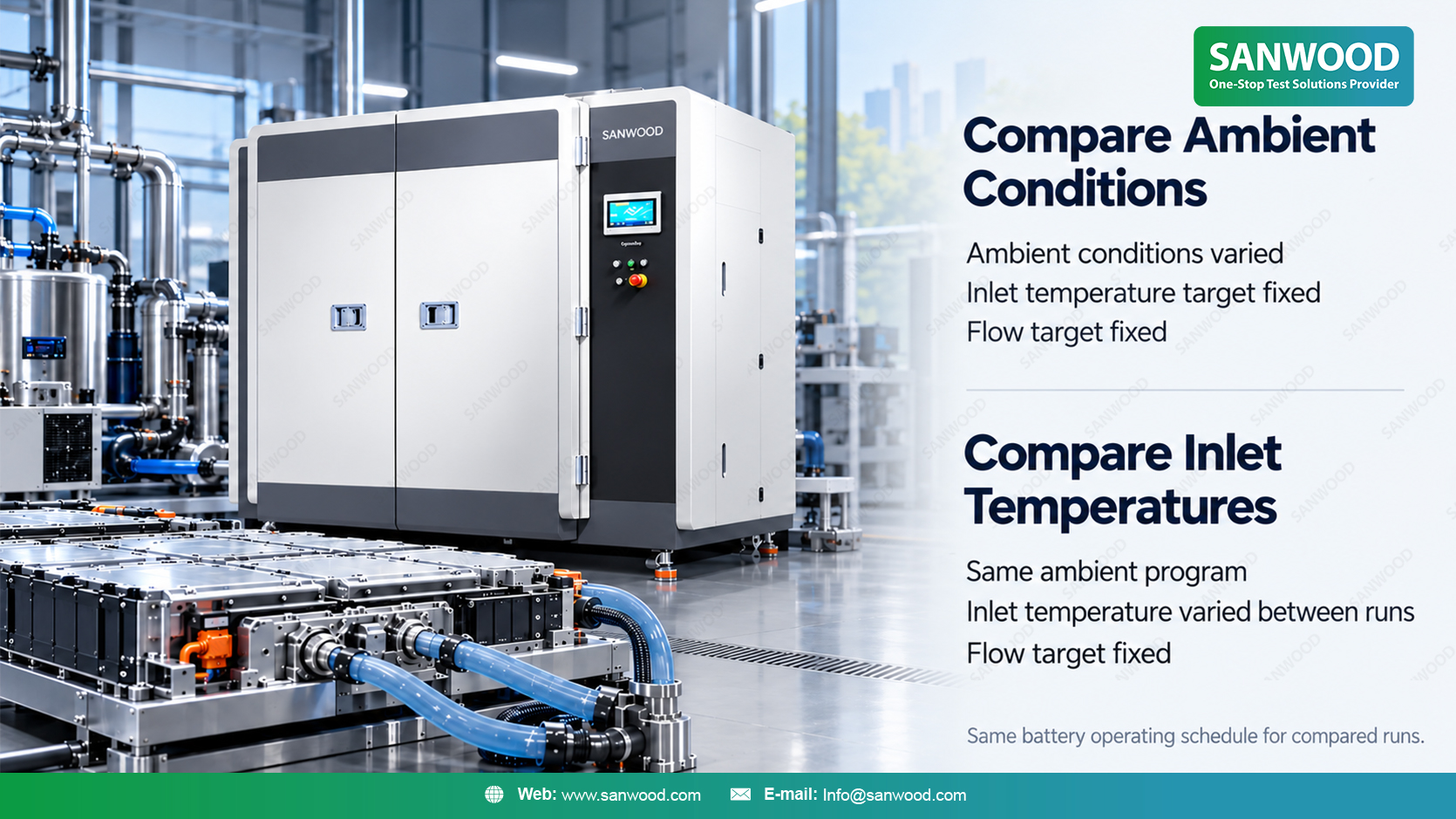
An ambient program does not specify the coolant conditions. The test plan needs to address both.
| Test purpose | Ambient requirement | Coolant requirement |
| Examine battery response across ambient conditions | Defined ambient changes | Fixed inlet-temperature and flow targets during the comparison |
| Compare coolant inlet temperatures | Same ambient condition or profile across compared runs | Different inlet-temperature targets; the same flow target |
| Follow an application scenario | Ambient program based on the documented scenario | Temperature and flow requirements drawn from the same scenario |
“Fixed” describes an unchanged target over a defined period. The plan should also state the permitted deviation and how the actual condition will be checked.
For example, an inlet-temperature comparison may use two runs with the same ambient program and battery operating schedule, but different coolant inlet-temperature targets. Define the starting conditions and use the same identified battery-temperature measurement locations. If flow also changes, describe the comparison as involving both variables.
The repeated ambient program can include temperature changes and dwell periods. Repeating a profile does not mean holding the chamber at one temperature.
For a Liquid-Cooled Battery Test Chamber, an inlet-temperature requirement needs an identified inlet. Mark the battery or cooling-plate inlet, return connection and measurement points on the connection drawing. Keep the conditioning-unit outlet separately identified so that each reading has a clear location.
The coolant specification should cover:
Fluid type and concentration.
Inlet-temperature target or program, with permitted deviation.
Flow target or program, including units and measurement location.
Permitted pressure at the identified connections.
Any allowable pressure difference across the test object.
Label pressure values as gauge, absolute or differential. The proposed arrangement should also identify whether flow or pressure is controlled, and which other conditions are monitored.
Include hoses, fittings and fixtures in the layout supplied with theSANWOOD enquiry. These details define the complete proposed circuit against which the coolant requirements need to be reviewed.
Fixed coolant inlet temperature and flow do not establish a fixed battery temperature. Battery temperature remains a measured response at the locations selected for the study.
Before comparing results, check the recorded chamber and coolant conditions against the requested program and tolerances. Keep any deviations associated with the affected test stage.
For an application-based program, retain the source and revision of the operating scenario together with the battery operating schedule. If a profile is illustrative, label it accordingly; a changing coolant-temperature curve alone does not demonstrate that vehicle operation has been reproduced.
An exposed surface below the surrounding air's dew point presents a condensation risk. The review therefore needs to consider cooling plates, hoses, connections and exposed battery surfaces, as well as chamber-air temperature.
Where the test procedure excludes condensation, define the relevant moisture and surface-temperature measurements, operating limits and moisture-control measures. Consider loading, temperature transitions and door opening where they affect the planned test.
The proposal should identify which moisture-control measures are included. A stated temperature range does not establish how condensation will be managed.
For energized tests, also define the required response to specified moisture, flow or pressure alarms. Identify which equipment must respond and the conditions for restarting. SANWOOD's battery chamber interlock article discusses coordination between chamber alarms and external battery cyclers.
A Liquid-Cooled Battery Test Chamber enquiry should include one schedule showing how the ambient program, coolant requirements and battery operation fit together. For each stage, identify the required conditions and whether progression depends on elapsed time or a specified measurement.
Alongside that schedule, provide battery dimensions, the connection layout, coolant details, measurement locations and information about existing equipment. Include the expected heat load where available, and clearly mark any information still to be confirmed.
This gives the enquiry a practical focus: where each condition applies, how it will be checked and which equipment must provide it. For chamber format and loading considerations, see the SANWOOD battery test chamber guide.
Send your test schedule and layout to SANWOOD to discuss the proposed chamber and coolant arrangement.
Compatibility needs to be assessed for the proposed circuit and operating conditions. Provide the unit's model, technical documentation, supported fluids, temperature and flow ranges, pressure information and capacity data under the intended conditions. Include its connections and available control and recording interfaces.
Provide the available battery information, intended operating schedule and coolant requirements, and mark the heat-load data as pending. Ask for the assumptions and further information needed for equipment selection to be identified. Any preliminary proposal should make clear which capacity or performance commitments remain subject to confirmation.
It should identify who supplies the battery cycler and electrical measurement instruments, along with the interfaces included between that equipment, the coolant system and the chamber. Electrical control, measurement and required alarm responses should each have an assigned role in the proposed setup
Sanwood is not just a company; it is a commitment to delivering high-quality products that stand the test of time.

 English
 中 文
中 文


 info@sanwood.com