2026-08-10 14:41:03
A semiconductor reliability test flow is most useful when it follows the failure risk, not the equipment list. Temperature, humidity, HAST, thermal shock, IC burn-in and dynamic aging each create different evidence. For ICs, HBM-related packages, Memory ICs, MCUs, SoC digital chips and storage-related semiconductor devices, SANWOOD helps connect environmental test chamber and climatic test chamber conditions with powered burn-in and high temperature dynamic aging when functional behavior also needs to be verified.
The practical question is not simply which chamber can reach a target condition. It is whether the test flow can explain how the device behaves under the stress it may face in qualification, production screening or field use.
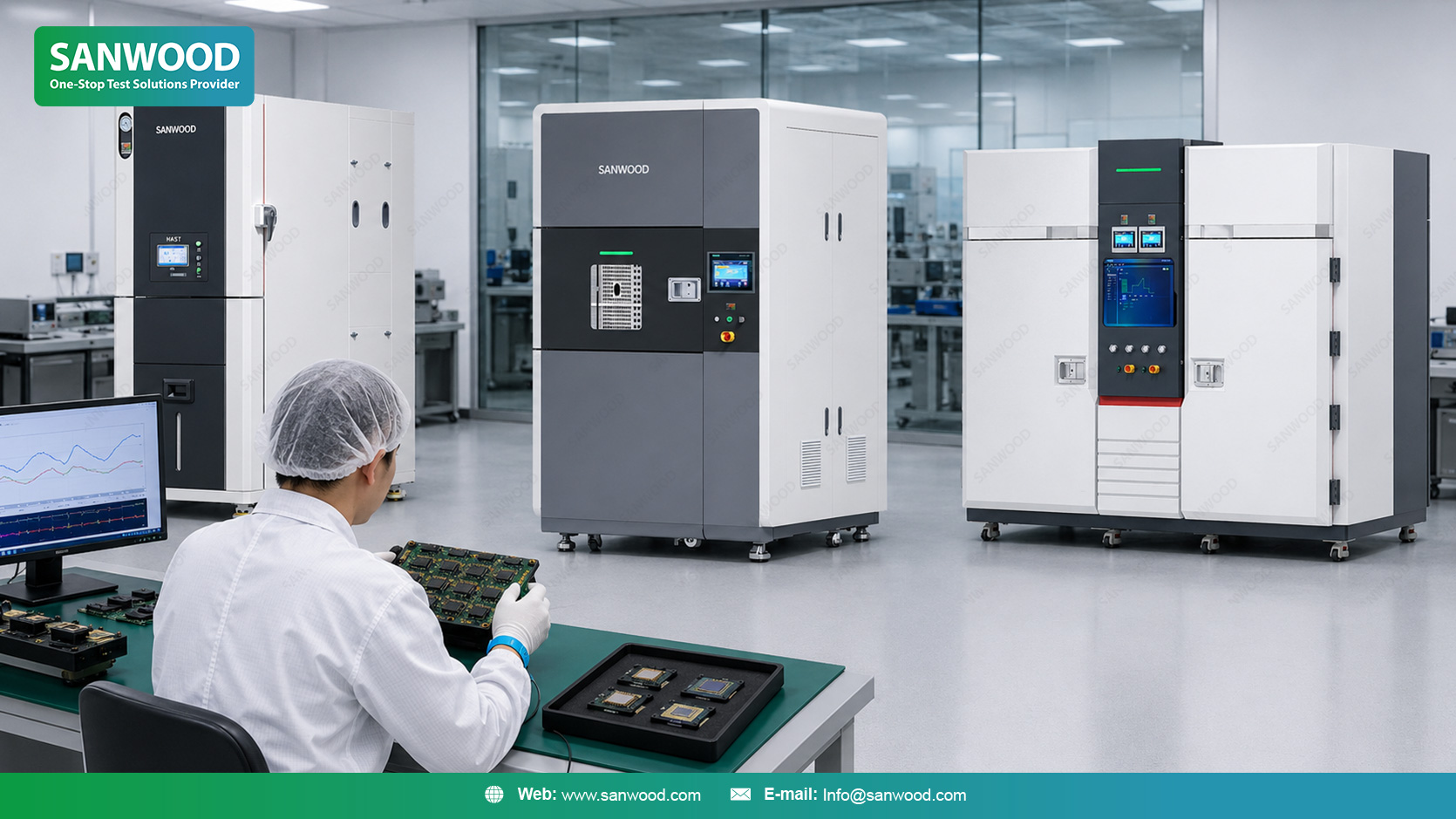
In many semiconductor projects, the equipment discussion starts with a familiar question: what temperature range do we need?
That question matters, but it comes too early if the failure mode is still unclear.
A packaged IC may need moisture-related evaluation. A memory device may need retention and read/write behavior checked after stress. An MCU may need powered response monitored during aging. An HBM stack or advanced package may need repeated thermal movement to expose interconnect, substrate or interface weakness. These are not the same problem, even if they all involve temperature.
This is why a useful semiconductor reliability test flow starts with the device and the risk. The chamber is selected after the team understands what the test is supposed to reveal.
For SANWOOD projects, that usually means clarifying the sample form, package structure, application environment, powered or unpowered state, expected failure mechanism and data that must be collected. Only then does it make sense to discuss an environmental test chamber, climatic test chamber, HAST chamber, thermal shock chamber, BIB temperature chamber or Memory Burn-in Test System.
Environmental stress testing gives engineers a controlled way to expose temperature, humidity and climatic risks before the device reaches a customer system.
A high and low temperature chamber may be used for hot operation, cold start checks, high temperature storage or lot comparison. A temperature humidity test chamber or climatic test chamber is more relevant when moisture, damp heat or broader climatic exposure is part of the reliability question.
For SANWOOD temperature humidity and climatic test chamber configurations, common project options may include temperature ranges such as -20 °C to +150 °C, -40 °C to +150 °C, -60 °C to +150 °C or -70 °C to +180 °C, depending on model and application. Humidity control may support 10%RH to 98%RH for damp heat and climatic testing. In applicable configurations, temperature fluctuation can be specified around +/-0.5 °C, while temperature uniformity, chamber volume, shelf loading, cable ports and communication options such as RS-232, RS-485 or Ethernet should be matched to the actual fixture and sample load.
These details are not just specification sheet items. For HBM-related packages and other dense semiconductor assemblies, fixture heat capacity, airflow shadowing and sensor placement can change what the sample actually experiences. The value of the test comes from repeatable stress at the device position, not only from the chamber setpoint.
Moisture risk is often hidden at the beginning of a project. The device may pass room-temperature electrical checks and still carry package interface, corrosion, insulation, leakage or stacked-package reliability risks that appear later.
Temperature humidity testing can support damp heat and general climatic exposure. HAST is different. It is selected when accelerated temperature, humidity and pressure are required to study moisture-related package or material behavior.
SANWOOD HAST accelerated aging chamber configurations may support high temperature, high humidity and pressure conditions for semiconductor package evaluation. Example operating conditions may include 105 °C to 135 °C, 70%RH to 100%RH and pressure up to about 2.3 kg/cm2, depending on the specific configuration and test method. Biased or unbiased testing, HBM or package fixture compatibility, pressure safety, humidity traceability and alarm records should be reviewed before the project is finalized.
The important point is that HAST should not be treated as a faster version of every humidity test. It answers a narrower and more accelerated moisture-stress question.
Thermal cycling and thermal shock are sometimes grouped together, but they are not the same engineering condition.
Controlled temperature cycling is used when repeated expansion and contraction are the concern. It can help evaluate solder fatigue, package stress, board-level reliability, connectors, HBM-related package interfaces and material mismatch over repeated transitions.
Thermal shock is more abrupt. It is used when sudden hot-cold transfer is the stress condition.
SANWOOD rapid-rate temperature change chamber configurations may support controlled rates such as 5 °C/min, 10 °C/min, 15 °C/min or 20 °C/min, depending on model and load. Suitable configurations may reach ranges such as -70 °C to +180 °C. For chip-level thermal testing, SANWOOD thermal test system configurations may also support -70 °C to +180 °C with fast transition response.
For thermal shock testing, SANWOOD chamber configurations may support temperature impact ranges such as -65 °C to +150 °C. Transfer time, recovery behavior, sample basket size, fixture material and sample mass should be reviewed because the actual stress depends on the loaded system, not only the empty chamber.
This is where reliability planning becomes practical. The same device may need cycling for fatigue evaluation, shock for transition weakness, or neither if the real risk is electrical behavior during operation.
Some semiconductor risks do not appear until the device is powered.
An unpowered sample can reveal storage, material or package behavior. A powered sample can reveal current shift, communication instability, abnormal pin response, early-life defects or functional drift under temperature.
For burn-in board applications, a SANWOOD BIB temperature test chamber can be configured around the actual burn-in process. Project examples may use a customized temperature range such as -40 °C to +150 °C. Operation modes may include manual loading and unloading, automatic chamber door options, visual operation interface and manual or automatic operation mode.
For production and lab environments, daily usability also matters. Working noise may be specified at an A-weighted sound pressure level not higher than 75 dB(A) under defined measurement conditions. ESD wrist strap interfaces can support anti-static semiconductor handling. Communication may support serial port, network port or USB, with open PLC communication interfaces when required. PLC point maps and upper-computer communication protocol support can help connect the chamber with customer test systems or production data platforms.
This is why BIB testing belongs in a reliability flow rather than only in an equipment catalog. It connects controlled temperature with powered device screening, operator workflow and data traceability.
Dynamic aging is used when engineers need to know how the device behaves while the stress is being applied.
For Memory ICs, FLASH, DRAM, MCUs, digital logic devices and SoC digital chips, a Memory Burn-in Test System or High Temperature Dynamic Aging Test System may be more suitable than a chamber-only setup. The device is not only exposed to heat; it is driven, checked and compared during aging. In HBM-related reliability projects, this same principle matters: environmental stress is more useful when it is connected to the electrical evidence the package or device program actually needs.
SANWOOD Memory Burn-in Test System configurations are intended for low and medium power devices, especially devices with power consumption up to 10 W. Typical package forms may include QFN, QFP, BGA, SOP, SSOP and TSSOP. The aging environment may support room temperature +10 °C to 150 °C, depending on project configuration.
For the electrical side of the system, key performance points may include 184 I/O single-board signal channels, 64M Words maximum programming depth, 20 MHz maximum signal frequency, 8 Edges, VIH = 0.6 V to 5.5 V, VIL <= 0.8 V, +/-200 mA drive current capability, Tr <= 10 ns, Tf <= 10 ns, and window comparator reference levels of VOH 0.6 V to 5.5 V and VOL 0.6 V to 5.5 V. TDBI technology supports logic function testing during the aging process.
This stage is valuable because it can reveal failures that are invisible in static storage. A device may pass before aging and after aging checks, but still show unstable behavior while it is active under temperature.
A complete semiconductor reliability flow rarely uses every method. It uses the methods that match the risk.
Package moisture risk may lead to temperature humidity testing or HAST. HBM and advanced packaging concerns may lead to tighter attention on fixture design, temperature uniformity, thermal transitions and correlation with electrical data. Thermal fatigue may lead to rapid temperature change or cycling. Abrupt transition weakness may lead to thermal shock. Early-life powered defects may lead to BIB burn-in. Logic behavior during aging may lead to a Memory Burn-in Test System.
The flow becomes stronger when each stage creates evidence that can be traced. If a device fails, the team should know the chamber profile, sample position, board channel, power state, test pattern, lot, package and failure time. Without that context, the test may confirm that stress was applied, but it may not explain what happened.
Semiconductor reliability test flows often reference international standards, customer specifications or internal qualification methods. The correct reference depends on the device type, application field and reliability objective.
Common references may include:
JEDEC JESD47 for stress-test-driven qualification of integrated circuits
JEDEC JESD22-A108 for temperature, bias and operating life test methods
JEDEC JESD22-A103 for high temperature storage life
JEDEC JESD22-A104 for temperature cycling
JEDEC JESD22-A110 for highly accelerated temperature and humidity stress testing
AEC-Q100 for failure-mechanism-based stress test qualification of packaged ICs in automotive applications
AEC-Q100-008 for early life failure rate evaluation
AEC-Q100-005 for non-volatile memory endurance, retention and operational life considerations
JEDEC JESD235 series as an important reference family for high bandwidth memory device characteristics and HBM-related engineering context
IEC 60068-2-2 for dry heat testing
IEC 60068-2-14 for change of temperature
ISO 16750-4 for climatic load references in road vehicle electrical and electronic equipment projects
These references are not interchangeable. JEDEC and AEC methods are often used for semiconductor device qualification, while IEC and ISO references may support broader environmental or application-level validation. A chamber supports the condition, but the complete test flow also depends on fixtures, sample loading, electrical systems, monitoring and pass/fail criteria.
SANWOOD Technology provides environmental test chamber, climatic test chamber and semiconductor reliability test system solutions for ICs, HBM-related packages, memory devices, MCUs, storage devices, automotive electronics, industrial electronics and advanced electronics.
For semiconductor reliability flow projects, SANWOOD can help review the device type, package form, application environment, stress method, fixture design, heat load, airflow influence, cable ports, monitoring needs, BIB or dynamic aging requirements, applicable standards and long-term service needs.
The useful work is not limited to selecting one chamber model. It is matching the reliability question to the chamber configuration, test system, operating workflow and support plan. SANWOOD also supports global installation, maintenance, repair and long-term service for customers who need stable equipment operation after delivery.
A semiconductor reliability test flow is a planned sequence of environmental, climatic, powered and dynamic tests used to evaluate reliability risks in ICs, HBM-related packages, memory devices, MCUs, packages, boards or modules.
Failure risk determines the stress method. Moisture risk, thermal fatigue, abrupt transition weakness, early-life defects and powered logic instability require different test conditions and equipment configurations.
An environmental test chamber creates controlled temperature, humidity or cycling conditions. In semiconductor projects, it supports reliability validation for components, packages, boards and modules.
A climatic test chamber supports controlled temperature and humidity exposure. It is commonly used for damp heat testing, climatic validation, board-level evaluation and broader environmental reliability testing.
BIB testing is needed when ICs are mounted on burn-in boards and powered under controlled temperature for early failure screening, batch aging or powered reliability evaluation.
Dynamic aging is needed when the device must be driven and checked while it is being stressed. This is common for Memory ICs, MCUs, SoC digital chips, FLASH and DRAM devices that need logic behavior verified during high temperature aging.
HBM-related reliability work usually needs careful control of temperature exposure, thermal transition behavior, package fixture design and correlation with electrical test data. Depending on the qualification plan, the flow may include environmental testing, climatic testing, HAST, thermal cycling, thermal shock or powered evaluation rather than one single chamber method.
A practical semiconductor reliability test flow is built around the device, application and failure mechanism. Temperature, humidity, HAST, thermal shock, burn-in and dynamic aging all have a place, but they should be selected for a reason.
For teams planning semiconductor qualification, HBM-related reliability testing, memory device testing, MCU aging, IC burn-in or advanced electronics validation, SANWOOD can help review the complete path from environmental stress to dynamic aging. When the test purpose, sample condition and data requirement are defined early, it becomes much easier to choose the right chamber and test system configuration.
Sanwood is not just a company; it is a commitment to delivering high-quality products that stand the test of time.

 English
 中 文
中 文


 info@sanwood.com