2026-07-29 14:56:39
Enterprise SSDs used in AI data centers are not passive storage devices. They support model data, inference services, checkpoint writing, caching layers, vector databases, log storage, and fast recovery after hardware maintenance. When storage behavior changes, the effect can move beyond one drive and become a system reliability problem.
This is why enterprise SSD temperature testing needs to be closer to real data center conditions. A drive may pass a short room-temperature check, but behave differently under sustained workload, elevated temperature, limited airflow, or repeated thermal stress.
For SSD manufacturers, server suppliers, cloud hardware teams, and reliability labs, the key question is not only whether the drive can power on. It is whether the enterprise SSD can keep stable performance, data integrity, controller response, and firmware behavior while temperature and workload change together.
For this type of validation, a stable environmental test chamber or climatic test chamber is part of the test evidence. SANWOOD Enterprise SSD High and Low Temperature Test Chamber solutions are designed to support powered SSD operation, sample loading, workload testing, cable routing, anti-condensation control, and repeatable hot and cold test conditions.
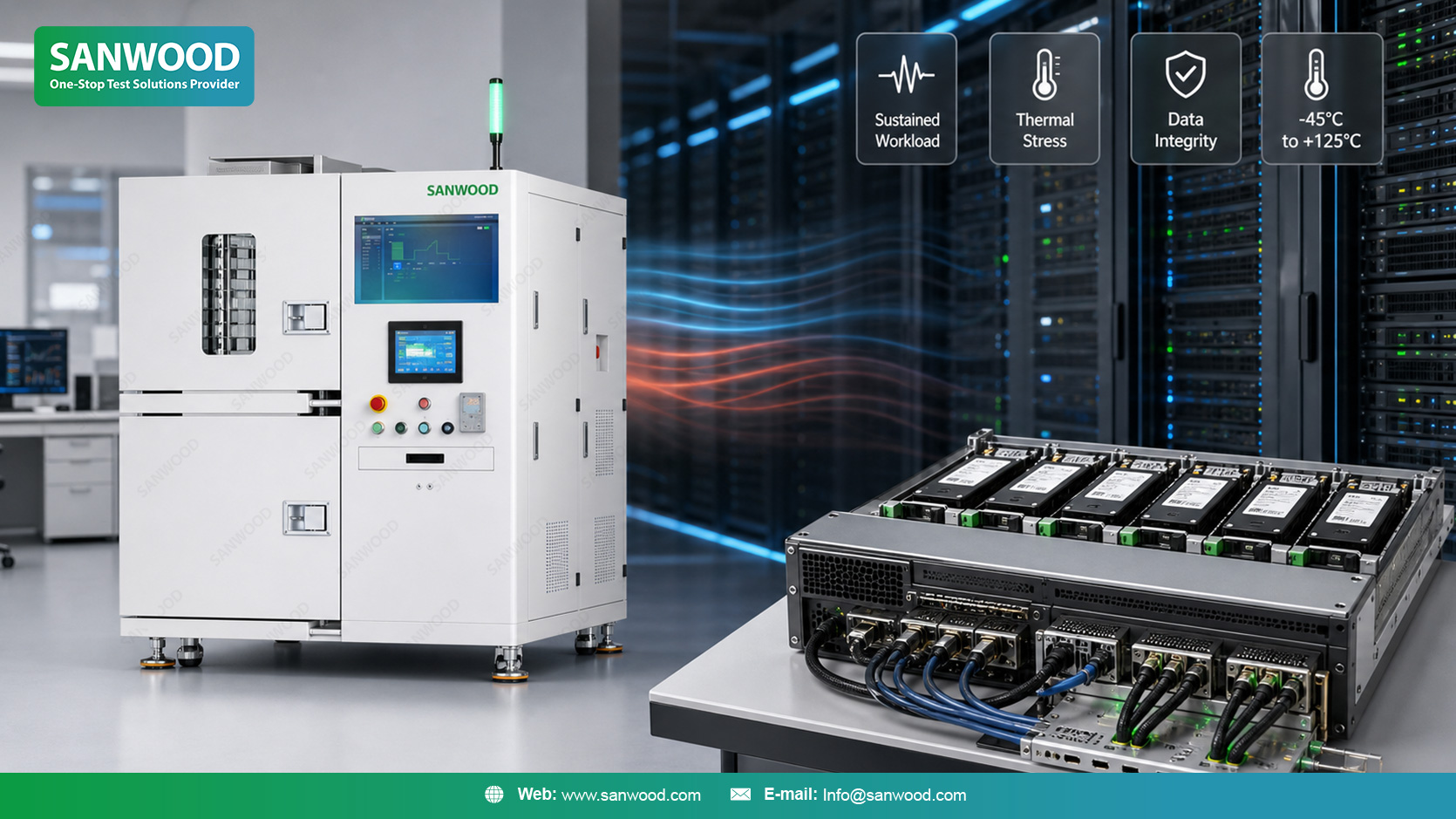
AI servers create a dense thermal environment. GPUs, CPUs, memory, network cards, power modules, and SSDs all compete for airflow and cooling margin. Depending on the server layout, an SSD may be installed in a U.2 bay, U.3 carrier, M.2 slot, EDSFF module, PCIe AIC, backplane fixture, or custom storage tray.
Each position may experience a different inlet temperature, local hot spot, or airflow restriction. At the same time, AI workloads can create long read-write periods and uneven power consumption. Training jobs may write checkpoints. Inference systems may load model files frequently. Retrieval and database applications may generate mixed read-write access for long periods.
Temperature testing helps evaluate risks such as:
Performance drop near thermal throttling limits
Controller and firmware response under heat
NAND behavior during write-heavy operation
Power consumption change under workload
Error log changes and media error behavior
Data integrity after hot or cold exposure
Retention concerns after storage or high-temperature operation
Connector, solder joint, PCB, and carrier stress
Drive-to-drive variation under the same test condition
This makes enterprise SSD testing different from eMMC testing in automotive or edge devices. The focus is less on compact-device cold start, and more on data center workload stability, heat load, drive telemetry, and multi-sample consistency.
SANWOOD Enterprise SSD High and Low Temperature Test Chamber configurations can be reviewed around the actual SSD form factor, sample quantity, fixture, heat load, and monitoring method.
Typical performance and configuration points may include:
Temperature range under full load: -45℃ to +125℃
Sample load reference: 4 kg electronic components, adjustable according to aluminum weight correction
Heat load reference: 1000 W
Chamber design focused on preventing condensation and frost inside the workspace
Polymer membrane compressed-air dryer for low-dew-point dry air supply
Minimum dry-air dew point: -40℃
Recommended compressed air supply: 7-8 bar
Air inlet dew point reference: < +5℃
Dry air flow reference: 0.3-0.5 m3/min
Cable and fixture support for powered SSD tests, telemetry collection, and read-write workload monitoring
These details matter because enterprise SSD testing often includes powered samples and heat-generating operation. If the chamber cannot control condensation during low-temperature operation, the risk shifts from reliability validation to sample damage. If the heat load is underestimated, the test profile may no longer match the planned condition.
The dry-air system is especially important for low-temperature testing. During low-temperature tests, dry compressed air can be introduced into the chamber to dilute moisture and maintain positive pressure. During temperature rise, the chamber air is already dry, so water vapor has less chance to condense on the product surface. This helps reduce frost and condensation risk during hot-cold transitions.
For SSD validation, chamber performance should be judged under the actual loaded condition, not only by empty-chamber temperature range.
An enterprise SSD is a compact electronic system. NAND flash, controller ASIC, firmware, power management, DRAM or SRAM resources, capacitors, PCB, connector, enclosure, and thermal path all respond to temperature.
At high temperature, the controller may enter a thermal management state. The drive may reduce performance to protect itself. Error correction workload may change. NAND behavior and retention margin may shift. Power consumption may move with workload and internal management activity.
At low temperature, power-on behavior, detection, timing margin, and communication stability may need attention. Repeated temperature change can also stress solder joints, connector interfaces, and mechanical carriers.
A meaningful enterprise SSD test should therefore combine chamber control with drive telemetry, workload logs, host-side monitoring, error reporting, and post-test data verification. Temperature alone is not enough. Workload alone is not enough. The useful evidence comes from testing both together.
Enterprise SSD temperature testing may reference several layers of standards and industry documents. Some relate to SSD interface and workload behavior. Others describe data center environmental conditions or component stress methods.
Relevant references may include:
NVMe Base Specification: PCIe SSD communication, management, and telemetry behavior
OCP Datacenter NVMe SSD Specification: commonly referenced in cloud and hyperscale SSD requirements
JESD218: solid-state drive requirements and endurance test method
JESD219: solid-state drive endurance workloads
ASHRAE TC 9.9 Thermal Guidelines: data center environmental guidance for IT equipment inlet conditions
IEC 60068-2-1: cold testing
IEC 60068-2-2: dry heat testing
IEC 60068-2-14: Test N, change of temperature
IEC 60068-2-78: Test Cab, damp heat, steady state
JESD22-A103: high temperature storage life, when storage exposure is part of the plan
JESD22-A104: temperature cycling, when repeated temperature change is required
These references should not be treated as one single test. NVMe and OCP relate more to SSD behavior, telemetry, and data center drive expectations. JESD218 and JESD219 are connected to SSD endurance and workload concepts. ASHRAE TC 9.9 helps frame data center environmental conditions. IEC and JEDEC environmental methods may support cold, dry heat, damp heat, storage, or temperature cycling programs.
The chamber does not replace SSD protocol or workload tools. Its role is to provide the controlled thermal environment where those tools can produce reliable data.
For enterprise SSDs, a useful test plan should begin with the actual use case.
Important test questions include:
What SSD form factor will be tested: U.2, U.3, M.2, EDSFF, AIC, or custom module?
How many drives will be loaded at the same time?
Will the drives be idle, powered, or running workloads?
What read-write workload should be used?
Which telemetry values, error logs, and performance data should be recorded?
Where should sensors be placed: chamber air, drive inlet, controller area, NAND area, or fixture?
What heat load will the loaded samples generate?
Is anti-condensation protection required for low-temperature tests?
Is the program linked to NVMe, OCP, JEDEC, IEC, ASHRAE, or customer methods?
For early R&D, a simple powered drive setup may be enough. For qualification or customer comparison, the fixture should move closer to the intended installation. Drive trays, adapter boards, backplane fixtures, airflow guides, and repeatable cable routing can all affect the data.
A good setup makes the SSD the variable under study. A poor setup lets fixture layout, airflow blockage, cable routing, or condensation become part of the uncertainty.
Not every enterprise SSD reliability program needs the same environmental method.
For baseline hot and cold operation, an Enterprise SSD High and Low Temperature Test Chamber or Temperature Test Chamber is usually the starting point. When damp heat or storage exposure is required, a Temperature Humidity Test Chamber may be used. When controlled repeated transitions are needed, a Rapid Temperature Change Test Chamber may be more suitable. If the concern is abrupt hot-cold transfer stress, a Thermal Shock Test Chamber should be considered.
The method should match the reliability question:
High-temperature operation: workload stability, throttling behavior, error logs
Low-temperature operation: power-on, detection, timing, firmware response
High-temperature storage: retention and post-storage verification
Temperature cycling: connector, solder joint, PCB, and carrier stress
Damp heat: corrosion, insulation, material, and package-related risk
Thermal shock: abrupt transition weakness under severe stress
This keeps the test plan practical. The most severe test is not always the most useful one.
SANWOOD Technology provides environmental test chamber and climatic test chamber solutions for semiconductor, memory, enterprise SSD, server storage, electronics, and data center hardware reliability testing.
For AI data center storage applications, SANWOOD can help configure Enterprise SSD High and Low Temperature Test Chambers for powered operation, multi-sample loading, cable routing, fixture integration, anti-condensation protection, temperature monitoring, heat-load review, and long-duration workload testing.
Related product options may include High and Low Temperature Test Chambers, Temperature Test Chambers, Temperature Humidity Test Chambers, Rapid Temperature Change Test Chambers, and Thermal Shock Test Chambers, depending on the required test method.
The chamber discussion usually starts with the real sample and workload:
SSD form factor and sample quantity
Target temperature range and dwell time
Powered or unpowered test condition
Workload type and monitoring method
Fixture, tray, backplane, or cable arrangement
Heat load and airflow requirement
Condensation prevention requirement
Test standard or customer method
Data that must be recorded before, during, and after the test
These details help define chamber volume, airflow layout, cable ports, cooling capacity, dry-air configuration, temperature performance, monitoring access, and customization needs.
Enterprise SSD temperature testing is now part of AI data center reliability work.
As AI clusters become larger and more storage-intensive, SSD behavior under temperature stress becomes more important to system uptime, maintenance planning, and customer confidence. A drive that performs well at room temperature may behave differently under sustained workload, limited airflow, high inlet temperature, or repeated environmental stress.
If your team is planning enterprise SSD temperature testing for AI data centers, server storage, NVMe SSDs, or cloud hardware qualification, share the SSD form factor, sample quantity, workload plan, temperature profile, fixture design, heat load, anti-condensation requirement, and monitoring needs. SANWOOD can help review the Enterprise SSD High and Low Temperature Test Chamber configuration and recommend a practical test setup for your application.
Sanwood is not just a company; it is a commitment to delivering high-quality products that stand the test of time.

 English
 中 文
中 文


 info@sanwood.com