2026-07-28 14:58:35
In an embedded system, eMMC is easy to overlook until the product fails to boot, loses data, slows down, or behaves differently after temperature exposure.
Automotive control units, industrial computers, smart meters, edge AI gateways, surveillance devices, robotics controllers, telecom equipment, and embedded Linux systems all depend on stable storage. These products are rarely used in clean room-temperature conditions. They may start in winter, run inside a sealed cabinet, sit in a roadside enclosure, or operate near heat-generating electronics for years.
This is where eMMC temperature testing becomes more than a component check. It helps confirm whether the memory device, host board, firmware, power design, and complete module can remain stable across the conditions the final product is expected to meet.
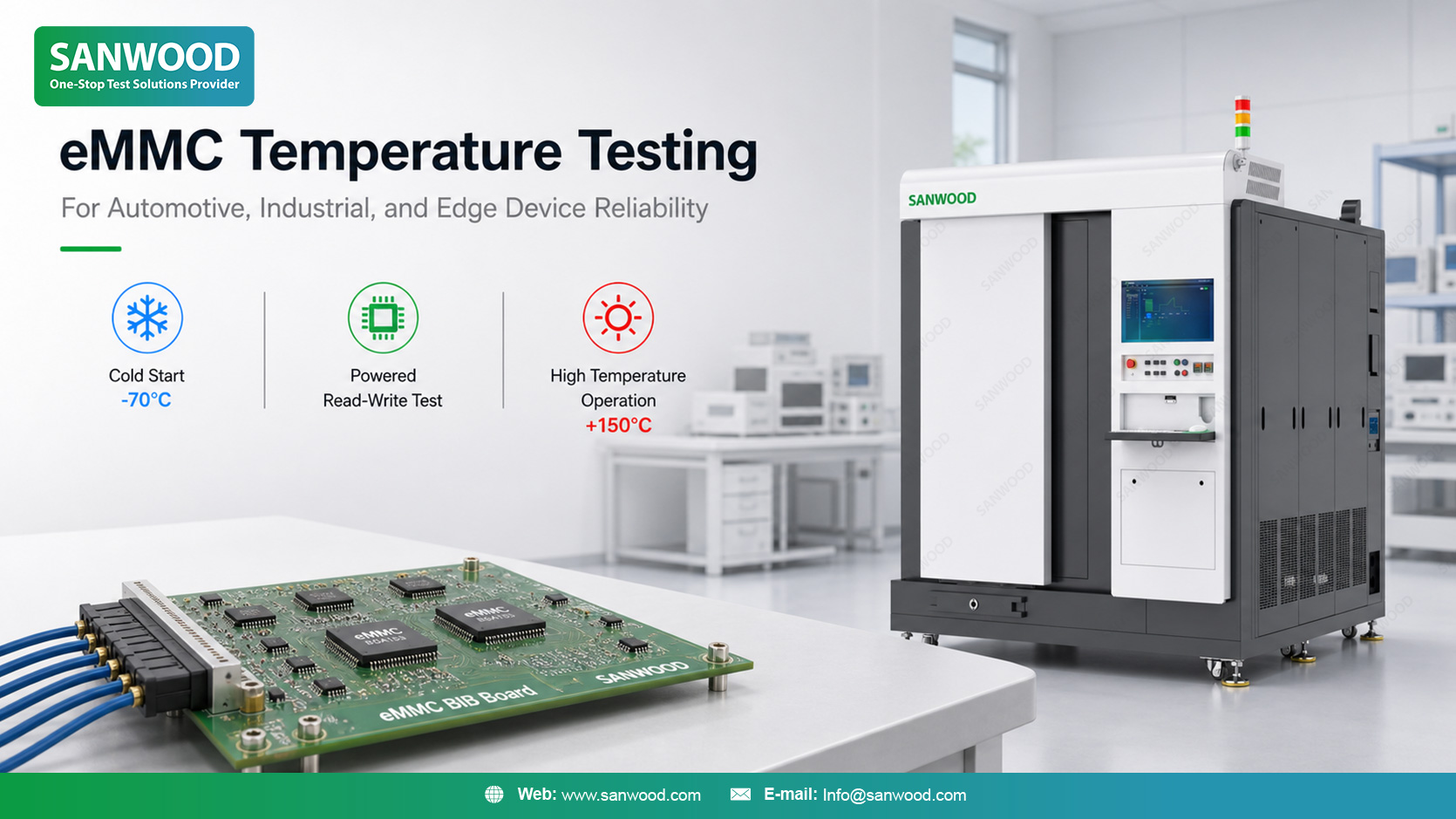
For this type of validation, a reliable environmental test chamber or climatic test chamber is essential. SANWOOD eMMC High and Low Temperature Test Chamber solutions are designed for automotive electronics, industrial devices, edge computing hardware, SSD-related products, 5G communication equipment, and electronic assemblies that need repeatable hot and cold testing under real sample loading conditions.
The core question is simple: can the eMMC keep stable boot, read-write, timing, retention, and communication behavior when temperature is no longer ideal?
An eMMC device is not just raw NAND flash. It combines flash memory, a controller, firmware, package materials, and a managed interface in one compact device. That integration makes product design easier, but it also means temperature can affect several layers at the same time.
Low temperature may slow initialization, reduce timing margin, or expose weak power-up behavior. High temperature may increase leakage, affect controller response, accelerate retention concerns, or reveal problems in board-level thermal design. Repeated temperature changes may stress the package, solder joints, PCB, and connectors.
Temperature exposure can influence:
Boot stability and initialization time
Read-write behavior under load
Controller and firmware response
Timing margin between eMMC and host
Data retention after storage or operation
Error management behavior
Leakage current and electrical drift
Solder joint and board-level connection reliability
Package material stress
System-level thermal design
A room-temperature function check only proves that the device works in one narrow condition. It does not show what happens after a cold start, long high-temperature dwell, powered read-write operation, or temperature cycling.
For automotive, industrial, and edge devices, that difference matters.
Automotive electronics create a tougher reliability discussion than most consumer products. An eMMC device may be used in infotainment systems, instrument clusters, telematics control units, gateway modules, data loggers, ADAS-related systems, battery management systems, or vehicle monitoring equipment.
The mounting location changes the temperature requirement. A cabin-mounted product does not experience the same stress as a module near a battery pack, powertrain area, roof-mounted device, or outdoor-connected enclosure. The same eMMC family may therefore face very different qualification expectations depending on where and how the final product is used.
Automotive projects often reference AEC-Q100 temperature grade concepts for packaged integrated circuits. Common operating ranges include -40℃ to +85℃, -40℃ to +105℃, -40℃ to +125℃, and in the most severe grade, -40℃ to +150℃. The actual profile depends on the component grade, customer specification, vehicle location, and safety or data-critical function.
For eMMC products, the temperature test plan may include low-temperature boot, high-temperature operation, temperature cycling, high-temperature storage, powered read-write testing, and post-stress data checks. Some programs also combine temperature exposure with humidity, electrical monitoring, or board-level validation.
The test should follow the real mounting environment, not a generic temperature number copied from a datasheet.
Industrial and edge products do not always follow the same qualification language as automotive projects, but their field conditions can be just as demanding.
An industrial controller may operate for years inside a cabinet with limited airflow. An edge AI gateway may sit in a roadside enclosure where summer heat and winter cold are both realistic. A smart energy device may write data every day while exposed to outdoor temperature swings. A surveillance system may need stable boot and storage after long operation in a sealed housing.
For these products, eMMC temperature testing is often used to check whether storage behavior remains predictable during:
Cold start after long power-off periods
High-temperature boot and operation
Continuous read-write activity under heat
Firmware loading after thermal exposure
Data logging during temperature dwell
Recovery after temperature cycling
Long storage before installation
System-level operation with the final PCB or module
This is why a Temperature Test Chamber or High and Low Temperature Test Chamber becomes part of product reliability planning. It gives product teams and test labs a controlled way to reproduce temperature stress before the product is installed in the field.
eMMC temperature testing may involve several layers of standards. The eMMC device itself is related to JEDEC electrical standards, while environmental reliability programs may reference automotive, IEC, ISO, JEDEC, or customer-specific stress methods.
Commonly referenced standards and methods may include:
JESD84-B51B: eMMC Electrical Standard 5.1B for embedded MultiMediaCard devices
AEC-Q100: failure mechanism based stress test qualification for packaged integrated circuits used in automotive applications
ISO 16750-4: road vehicles environmental conditions and testing for electrical and electronic equipment, Part 4 for climatic loads
IEC 60068-2-1: cold testing
IEC 60068-2-2: dry heat testing
IEC 60068-2-14: Test N, change of temperature
IEC 60068-2-78: Test Cab, damp heat, steady state
JESD22-A103: high temperature storage life, when storage stress is part of the qualification plan
JESD22-A104: temperature cycling, when repeated temperature change is part of the stress method
These standards do not all describe the same test. Some define electrical behavior. Some define cold, dry heat, damp heat, or temperature change methods. Some are used for automotive qualification, chamber performance reference, or customer-specific reliability planning.
For test labs, purchasing teams, and product manufacturers, the important step is to match the chamber capability with the profile being followed. A wide temperature range is useful, but it is not enough. The chamber also needs to support sample loading, fixtures, powered operation, cable routing, data monitoring, and stable control throughout the planned test.
For eMMC and embedded storage testing, chamber selection should start from the actual sample setup.
SANWOOD eMMC High and Low Temperature Test Chamber configurations can support temperature testing for eMMC, SSD-related products, electronic modules, automotive electronics, 5G communication products, and industrial devices. Chamber configuration can be reviewed around volume, temperature range, load capacity, cooling method, cable access, BIB board layout, power supply, communication interface, and monitoring requirements.
For a typical SANWOOD eMMC temperature chamber configuration, key performance points may include:
Temperature range: -70℃ to +150℃
Inner chamber volume: 588 L
Temperature fluctuation: ≤±0.5℃
Temperature deviation: ≤±2℃
Temperature uniformity: ≤±2.0℃
Heating rate: -50℃ to +85℃, about 5℃/min under non-linear full-process conditions
Cooling rate: +85℃ to -50℃, about 5℃/min under non-linear full-process conditions
Cooling method: water-cooled
BIB board loading: 12 layers, with independent power switch design for each layer
Heat load reference: each BIB layer can be reviewed around 5V/60A and 3000W heat-load requirements
Communication: RS485 and Ethernet interface options for PC connection and MES integration
Anti-static design: electrostatic wrist strap interface near the control panel
These specifications are important because eMMC validation is often performed with powered boards, fixtures, signal cables, and heat-generating loads inside the chamber. Empty-chamber performance does not fully represent a loaded test with BIB boards, active samples, and data monitoring.
Temperature range supports cold start and high-temperature operation checks. Temperature fluctuation and uniformity affect sample-to-sample comparability. Heating and cooling performance affect the real profile. Cable access and communication functions help support powered operation, read-write monitoring, and production test integration.
Cold start is one of the most realistic eMMC temperature tests.
A product may be powered off overnight in a cold environment, then expected to boot immediately. The eMMC must initialize, communicate with the host, load system files, and support the boot process while the PCB, solder joints, controller, and flash memory are all cold.
Cold testing can help reveal:
Slow or unstable initialization
Boot delay
Host communication errors
Timing margin weakness
Firmware loading problems
Intermittent read behavior
Board-level connection issues
For system manufacturers, the value of this test is that it looks at the interaction between the eMMC and the whole platform. The problem may come from the memory device, but it may also come from the host processor, power supply, PCB layout, connector, firmware, or operating system.
Testing the final board or module inside an environmental test chamber gives a more realistic result than testing only a loose component.
High temperature testing is not only about survival.
In many embedded systems, the eMMC is active while the product is hot. It may store logs, write event data, support firmware updates, manage system files, or handle repeated read-write activity while the enclosure temperature is already elevated. If the final product is sealed or installed near a heat source, the local temperature around the storage device may be higher than the outside environment.
High temperature operation can affect controller behavior, flash management, leakage current, timing stability, data retention, and error correction workload. It can also reveal weakness in board design, power supply stability, or enclosure thermal path.
A useful test plan should define whether the sample is powered, whether read-write activity is running, what data should be monitored, and whether the test is component-level, board-level, or system-level.
Without powered operation or post-stress data checks, the test may miss the behavior that matters most in the real product.
Not every eMMC project needs the same stress method.
Temperature cycling is useful when the concern is repeated expansion and contraction across the package, solder joints, PCB, connector, and module assembly. It can help evaluate accumulated stress from many low-high temperature transitions.
When controlled thermal transitions are required, a Rapid Temperature Change Test Chamber may be more suitable than a standard chamber. If the method calls for abrupt hot-cold transfer, a Thermal Shock Test Chamber should be considered instead.
Humidity may also be part of the same reliability plan. A Temperature Humidity Test Chamber can support damp heat exposure, temperature humidity storage, and broader climatic test chamber validation for electronic modules, automotive devices, and industrial products.
For many eMMC projects, the starting point is still practical: low-temperature boot, high-temperature operation, storage exposure, powered read-write testing, and post-test data verification. Cycling, humidity, or shock can be added when the package, board, customer requirement, or field condition justifies it.
SANWOOD Technology provides environmental test chamber and climatic test chamber solutions for automotive electronics, semiconductor devices, memory products, industrial electronics, and edge computing hardware.
For eMMC temperature testing, SANWOOD can help review chamber configuration around eMMC High and Low Temperature Test Chambers, Temperature Test Chambers, Temperature Humidity Test Chambers, Rapid Temperature Change Test Chambers, and Thermal Shock Test Chambers, depending on the required test method.
The chamber discussion usually starts with the application and the sample:
Is the product automotive, industrial, outdoor, or edge computing equipment?
What eMMC device, board, or module will be tested?
What temperature range is required?
Is the test based on AEC-Q100, ISO 16750-4, IEC 60068, JEDEC, GB, GJB, or a customer method?
Will the sample be powered during the test?
Will read-write activity, boot behavior, or data retention be monitored?
How many samples or BIB board layers will be loaded?
What fixtures, shelves, cables, and sensor points are needed?
Is humidity exposure, rapid temperature change, or thermal shock also required?
What data should be recorded before, during, and after the test?
These details help define chamber size, airflow layout, port configuration, temperature performance, heat load handling, monitoring access, and customization needs.
eMMC temperature testing is part of the reliability story for any product that depends on stable embedded storage in harsh or variable environments.
As automotive, industrial, and edge devices become more connected and software-defined, memory stability becomes a practical field reliability issue. Cold start, high temperature operation, powered read-write behavior, and post-stress data verification all help reduce risk before the product is installed in a vehicle, factory, cabinet, outdoor enclosure, or edge computing system.
If your team is planning eMMC temperature testing for automotive electronics, industrial devices, edge AI hardware, embedded controllers, or outdoor electronic systems, share the device type, test standard, temperature profile, sample loading, powered-test requirement, fixture design, heat load, and monitoring needs. SANWOOD can help review the eMMC High and Low Temperature Test Chamber configuration and recommend a practical test setup for your application.
Sanwood is not just a company; it is a commitment to delivering high-quality products that stand the test of time.

 English
 中 文
中 文


 info@sanwood.com