2026-07-23 15:28:17
HAST testing is not just a faster humidity test.
For semiconductor packages, Memory ICs, eMMC devices, enterprise SSDs, controllers, sensors, PCB assemblies, and advanced electronic modules, moisture-related reliability risks are often hidden until temperature, humidity, pressure, electrical bias, and time are combined. A product may pass incoming inspection, room-temperature function checks, or ordinary damp heat exposure, but still show weakness under accelerated moisture stress.
That is why HAST, or Highly Accelerated Stress Test, is widely used in semiconductor reliability programs. It helps packaging labs, memory suppliers, automotive electronics manufacturers, test centers, and quality teams evaluate package sealing, material interface stability, insulation behavior, corrosion paths, leakage current change, and moisture resistance in a shorter test cycle.
The value of HAST is not only acceleration. The value is earlier visibility. When moisture-sensitive weaknesses are found before customer qualification or mass production, material selection, package design, process control, and supplier decisions can still be improved.
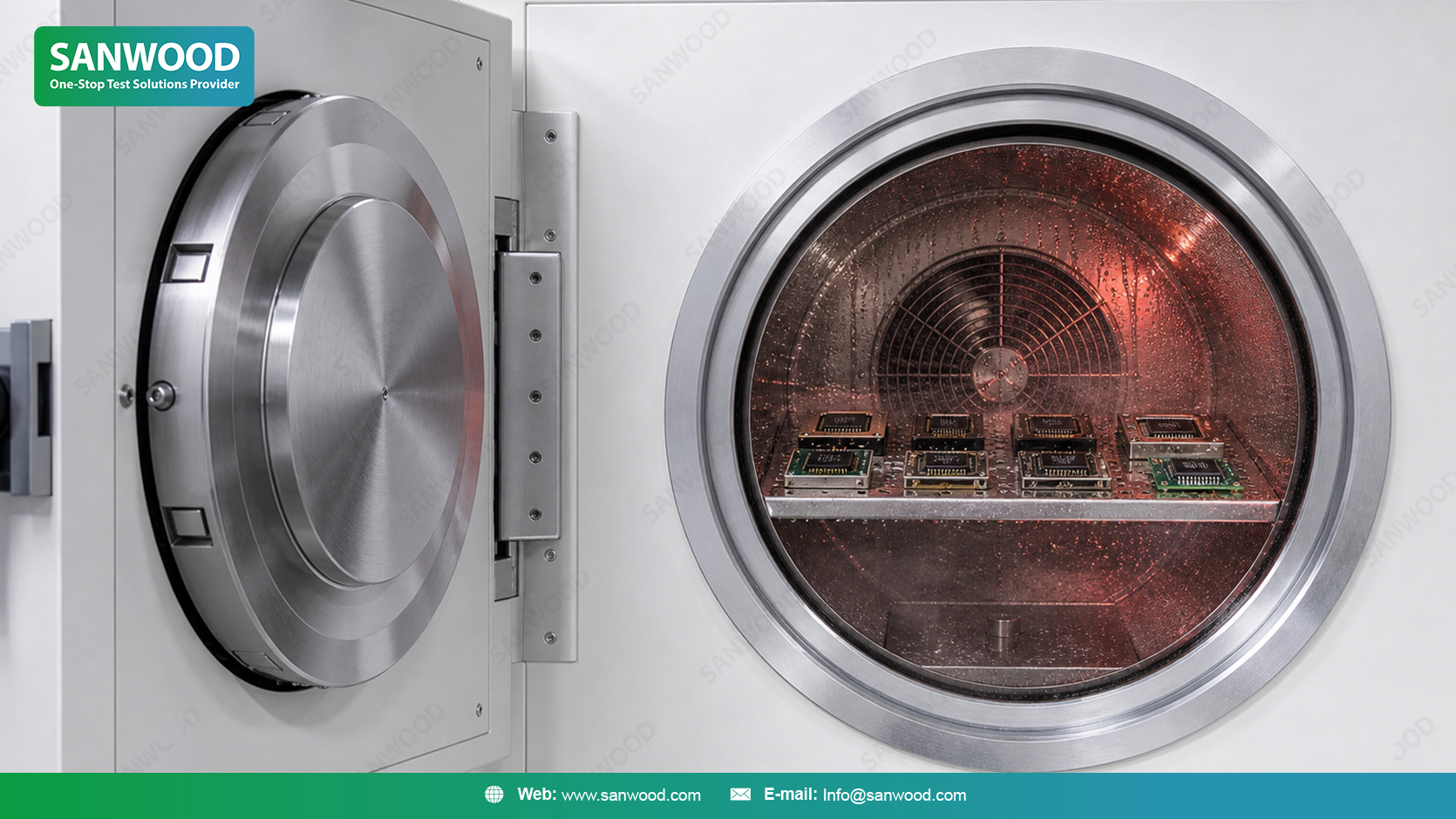
A Temperature Humidity Test Chamber is useful for controlled heat and moisture exposure under atmospheric pressure. It supports damp heat testing, storage testing, product validation, material comparison, and general electronics reliability work.
HAST is different.
A HAST Accelerated Aging Test Chamber applies high temperature, high humidity, and pressure to accelerate moisture penetration and moisture-related degradation. In semiconductor packages, this matters because the package is not only a protective cover. It is a structure made from molding compound, substrate, die attach, passivation layers, metal traces, solder, underfill, terminals, and many material interfaces.
When moisture enters weak areas, the result may appear as leakage, electrical drift, corrosion, insulation resistance change, electrochemical migration, delamination, or intermittent failure under bias. These problems may not appear in a short functional check, but they can affect long-term reliability in field applications.
For semiconductor manufacturers and device buyers, HAST helps answer a practical question: can the package maintain stable electrical and material performance when moisture stress is accelerated?
For semiconductor, memory, and automotive electronics projects, HAST chamber selection is often linked to international reliability standards and customer-specific qualification plans. A suitable HAST Accelerated Aging Test Chamber should support test programs that reference common damp heat, pressure humidity, and biased humidity methods.
Relevant standards may include:
IEC 60068-2-66, Test Cx: Damp heat, steady state, unsaturated pressurized vapour
JESD22-A110: Highly Accelerated Temperature and Humidity Stress Test, commonly used for biased HAST
JESD22-A118: Unbiased Highly Accelerated Temperature and Humidity Stress Test, often used for UHAST evaluation
JESD22-A101: Steady-State Temperature Humidity Bias Life Test
JESD22-A102: Accelerated Moisture Resistance, often associated with Pressure Cooker Test (PCT)
JESD22-A100: Cyclic temperature and humidity excursion life test
ISO 16750 series: environmental conditions and testing for electrical and electronic equipment in road vehicles
These standards do not all describe the same test. Some focus on steady-state damp heat. Some focus on biased humidity life testing. Some are used for pressure humidity or automotive environmental validation. The point is to match the chamber capability, sample setup, and test condition to the specific standard or customer method being followed.
For purchasing teams and test labs, this is an important detail. A chamber may look suitable by name, but the real question is whether it can support the required temperature, humidity, pressure, bias wiring, sample loading, and long-run control performance for the intended test method.
HAST testing depends on stable control under demanding conditions. For semiconductor packages and memory devices, useful chamber performance is not limited to the maximum temperature on a datasheet.
SANWOOD HAST chamber configurations can be selected around key performance requirements such as:
Temperature range: +105℃ to +135℃, with +145℃ available as a special optional model
Temperature fluctuation: ≤ 0.5℃
Temperature distribution: ≤ 3℃
Humidity range: 70%RH to 100%RH
Humidity fluctuation: ≤ 3%RH
Humidity distribution: ≤ 5%RH
Pressure range: 0.02 to 0.212 MPa gauge pressure, with 0.314 MPa available as a special optional model
Pressure fluctuation: +/-20 kPa
Pressure distribution: +/-20 kPa
Heating performance: normal temperature to +135℃, average throughout the whole process, about 60 minutes
These specifications help keep the test condition stable and repeatable. Temperature control affects moisture acceleration and electrical behavior. Humidity control affects the stress level applied to the package. Pressure control affects vapour penetration and consistency. Workspace distribution affects whether different samples in the same chamber receive comparable stress.
For biased HAST, performance is also tied to the fixture and wiring design. Cable ports, insulated feedthroughs, sample trays, monitoring points, and safety protection should be considered as part of the chamber configuration, not as afterthoughts.
Semiconductor packages are becoming smaller, denser, and more application-specific. AI processors, Memory ICs, MCU devices, power devices, automotive electronics, and advanced packaging structures all place greater pressure on package materials and interfaces.
Moisture can move through molding compound, collect near an interface, react with ionic contamination, or change electrical behavior when voltage is applied. In some cases, the package may look normal from the outside while internal reliability risk is already developing.
HAST testing is commonly considered when the application needs to evaluate:
Moisture resistance of IC packages
Package sealing and material interface reliability
Leakage current change under humid pressure conditions
Corrosion risk on metal traces, pads, or terminals
Insulation resistance degradation
Electrochemical migration under moisture and bias
Delamination or weak adhesion related to moisture exposure
Process differences between suppliers, lots, or material sets
Customer qualification requirements for semiconductor components
This makes HAST relevant for packaged ICs, Memory ICs, MCU devices, eMMC products, enterprise SSD components, automotive-grade electronics, sensors, connectors, and PCB-level assemblies used in high-reliability applications.
Memory reliability is often discussed through data retention, endurance, read-write behavior, controller response, timing stability, and error rate. Those items matter, but they do not replace package-level environmental validation.
Memory ICs, eMMC devices, and enterprise SSDs may be used in data centers, vehicles, industrial computers, edge AI systems, telecom equipment, and embedded controllers. These use cases may involve long storage before assembly, humidity exposure during transport, elevated temperature during operation, and long service life after installation.
For memory-related products, HAST testing helps narrow down questions that a basic pass-or-fail check cannot answer:
Does the package show leakage or drift after accelerated moisture exposure?
Does electrical bias create a different failure response than unbiased storage?
Are package materials and interfaces stable under humid pressure stress?
Do different suppliers or lots behave consistently?
Does moisture exposure affect module-level behavior after the test?
Are failures linked to package type, board design, assembly process, or material choice?
For this reason, a HAST Accelerated Aging Test Chamber can support more than qualification testing. It can also be used for failure analysis, supplier comparison, process improvement, incoming material evaluation, and reliability comparison during product development.
Before selecting the chamber configuration, the test method needs to be clear.
Unbiased HAST exposes samples to accelerated temperature, humidity, and pressure conditions without electrical bias. It is often used when the focus is package moisture resistance, material response, sealing performance, or general moisture-related degradation.
Biased HAST adds electrical bias during the test. This is important when the concern includes leakage paths, electrochemical migration, insulation breakdown, corrosion under voltage, or electrical stability under moisture stress.
The chamber setup changes when biased HAST is required. The project may need insulated feedthroughs, cable ports, fixtures, sample trays, wiring protection, data monitoring, and safety design inside a pressurized humidity environment.
This is why HAST chamber selection should not be based only on a temperature, humidity, and pressure rating. It should be based on the test method, sample type, fixture design, loading quantity, bias requirement, and monitoring plan.
HAST has a specific role in semiconductor reliability testing. It should not be treated as a replacement for every temperature or humidity method.
A Temperature Humidity Test Chamber is useful for controlled damp heat testing, storage exposure, and general climatic test chamber validation. A High and Low Temperature Test Chamber may be enough for temperature storage or operation checks. A Rapid Temperature Change Test Chamber supports controlled thermal cycling profiles. A Thermal Shock Test Chamber is used when sudden hot-cold transition stress is the main concern.
HAST is most relevant when the target risk is accelerated moisture-related degradation under high temperature, high humidity, and pressure. In a complete reliability plan, these methods may work together, but they answer different questions.
Thermal cycling helps evaluate repeated expansion and contraction. Thermal shock focuses on abrupt temperature transition. Temperature humidity testing supports longer damp heat exposure. HAST shortens the time needed to investigate moisture-driven package and electrical reliability risks.
The strongest test is not automatically the right test. The right method is the one that matches the expected failure mechanism and the application requirement.
SANWOOD Technology provides environmental test chamber and climatic test chamber solutions for semiconductor, memory, electronics, automotive, and industrial reliability testing.
For HAST applications, SANWOOD HAST Accelerated Aging Test Chambers support high temperature, high humidity, and pressure testing for semiconductor packages, Memory ICs, eMMC devices, enterprise SSD components, PCB assemblies, connectors, sensors, and other electronic components. Different configurations can be reviewed according to test standard, sample size, loading quantity, fixture design, bias requirement, pressure range, and monitoring needs.
For broader reliability programs, SANWOOD also supports related product categories, including Temperature Humidity Test Chambers, High and Low Temperature Test Chambers, Rapid Temperature Change Test Chambers, and Thermal Shock Test Chambers.
In real projects, SANWOOD usually begins by reviewing the sample and the test method:
What product or package will be tested?
Which standard or customer method should be followed?
Is the test biased or unbiased?
What temperature, humidity, and pressure condition is required?
How many samples will be loaded?
What fixture, tray, board, or carrier will be used?
Are cable ports, feedthroughs, or monitoring points needed?
What data needs to be recorded during the test?
Is the project for R&D, qualification, failure analysis, or production quality control?
These details help define chamber volume, control performance, pressure structure, safety design, wiring access, sample layout, and possible customization needs.
HAST testing is a focused method for evaluating moisture-related reliability in semiconductor packages and memory devices. It is especially useful when high temperature, high humidity, pressure, and bias may accelerate risks that are difficult to see in ordinary inspection.
As AI hardware, Memory ICs, eMMC products, enterprise SSDs, and advanced electronic modules become more valuable and more application-specific, reliability evidence becomes part of product competitiveness. HAST can help identify moisture-sensitive weaknesses before they become qualification delays, field returns, or customer confidence problems.
If your team is planning HAST testing for semiconductor packages, Memory ICs, eMMC devices, enterprise SSD components, or electronic assemblies, share the sample type, test standard, test condition, bias requirement, loading quantity, fixture design, and monitoring needs. SANWOOD can help review the chamber configuration and recommend a practical HAST accelerated aging test setup for your application.
Sanwood is not just a company; it is a commitment to delivering high-quality products that stand the test of time.

 English
 中 文
中 文


 info@sanwood.com