2026-07-22 11:43:44
Thermal cycling and thermal shock are often mentioned together in semiconductor reliability testing. Both methods expose devices to temperature stress. Both can help evaluate package reliability. Both may be used for IC packages, HBM-related devices, chiplet assemblies, advanced packaging samples, Memory ICs, eMMC, enterprise SSDs and electronic modules.
But they are not the same test.
For semiconductor manufacturers, packaging labs and reliability teams, the difference matters. Choosing the wrong test method can create misleading data, unnecessary failures or results that do not match the real failure mode. The better question is not simply, "Should we test hot and cold?"
It is: what kind of temperature stress should the product be evaluated against?
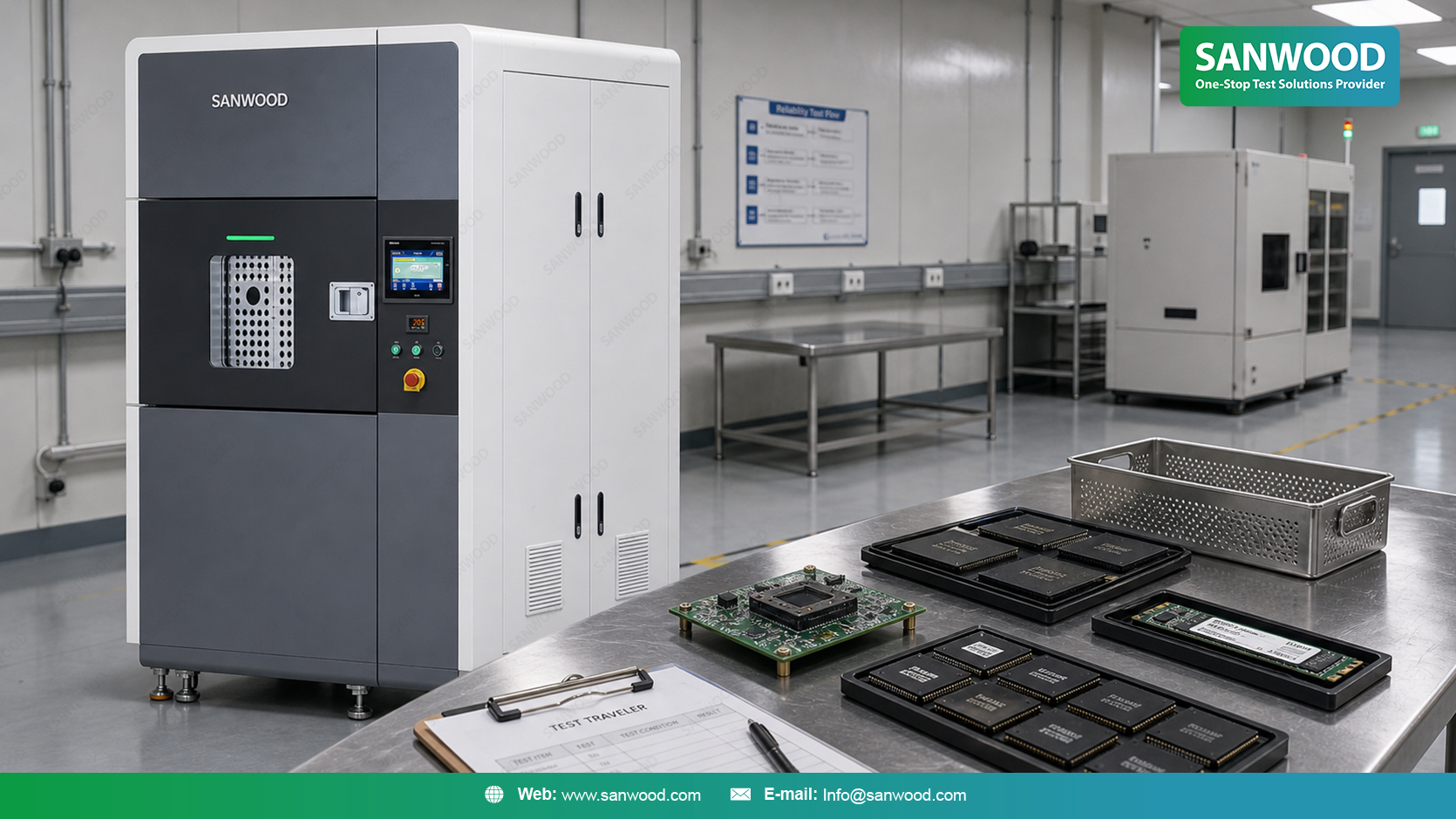
Thermal cycling testing moves samples between low and high temperature conditions over repeated cycles.
The key point is control.
A thermal cycling profile usually considers:
- Low-temperature dwell
- Controlled temperature ramp
- High-temperature dwell
- Cycle count
- Temperature stability
- Temperature uniformity
- Sample loading
- Sensor placement
- Recovery time
For HBM, chiplet and advanced packaging, thermal cycling is often used to evaluate repeated thermo-mechanical stress. When different materials expand and contract again and again, weak points may appear over time.
These risks may include solder joint fatigue, micro-bump fatigue, package warpage, interface delamination, substrate stress or board-level connection issues.
A Rapid Temperature Change Test Chamber is often used when the test requires controlled ramp rates, stable dwell periods and repeatable thermal cycling profiles.
Thermal shock testing applies a much faster temperature change.
Instead of gradually ramping the chamber temperature, samples are exposed to a sudden transition between hot and cold conditions. This may be done by moving the sample between separate temperature zones or by using a dedicated thermal shock structure.
Thermal shock is useful when the test goal is to expose weaknesses under abrupt temperature change.
It may be used to evaluate:
- Package cracking
- Interface separation
- Solder joint stress
- Material weakness
- Assembly-level stress
- Rapid hot-cold transition resistance
A Thermal Shock Test Chamber is usually more suitable when the main concern is sudden temperature transition rather than controlled ramp cycling.
Semiconductor packages are becoming more complex.
HBM stacks, chiplet architectures, AI processors and advanced packaging designs bring different materials into a smaller and denser structure. Silicon, substrate materials, solder, copper, underfill, molding compound and board materials do not expand at the same rate.
This creates CTE mismatch.
Under repeated thermal cycling, this mismatch may gradually lead to fatigue. Under thermal shock, the package experiences a more abrupt stress condition.
Both tests can reveal reliability risks, but they do not reveal them in the same way.
Thermal cycling is better suited for studying accumulated stress over repeated temperature changes.
Thermal shock is better suited for evaluating sudden hot-cold resistance.
Test Method | Main Purpose | Stress Style | Typical Focus |
Thermal Cycling | Repeated temperature change | Controlled ramp and dwell | Fatigue, warpage, interconnect reliability |
Thermal Shock | Sudden hot-cold transition | Abrupt transfer | Cracking, separation, rapid stress failure |
One method is not automatically better than the other.
The right choice depends on the reliability question, product structure and test objective.
Thermal cycling may be more suitable when the concern is:
- Repeated expansion and contraction
- Solder joint fatigue
- Micro-bump fatigue
- Package warpage over cycles
- Long-term package reliability
- Controlled ramp rate and dwell time
- HBM, chiplet or advanced packaging qualification
Thermal shock may be more suitable when the concern is:
- Sudden hot-cold transfer
- Package cracking
- Interface separation
- Rapid material stress
- Assembly weakness under abrupt temperature change
- Severe temperature transition resistance
In some semiconductor reliability programs, both tests may be used. But they should not be treated as interchangeable.
Whether the test is thermal cycling or thermal shock, sample loading matters.
Real tests may involve package samples, PCB carriers, socket fixtures, test coupons, thermocouple wires, powered devices or monitoring cables. These details affect the actual condition experienced by the sample.
For thermal cycling, dense fixtures may block airflow and slow the ramp response.
For thermal shock, fixture mass may affect how quickly the sample experiences the temperature transition.
This is why empty-chamber performance is not enough. The loaded test condition should be considered before the chamber is selected.
SANWOOD Technology provides environmental test chambers for semiconductor, memory and electronics reliability testing.
For controlled repeated temperature transitions, the Rapid Temperature Change Test Chamber can support thermal cycling tests with defined ramp rate, dwell time, temperature stability and repeatability.
For sudden hot-cold transition testing, the Thermal Shock Test Chamber is the more relevant product category.
In some projects, a High and Low Temperature Test Chamber may be enough for basic temperature exposure or storage testing. But for HBM, chiplet, AI processor and advanced packaging reliability work, chamber selection should be based on the stress profile, sample loading method and target failure mode.
The selection should start from the test purpose, not only from the temperature range.
Before choosing between thermal cycling and thermal shock testing, clarify:
- What product or package will be tested?
- What failure mode is being investigated?
- Is the concern repeated fatigue or sudden transition stress?
- What temperature range is required?
- What ramp rate or transfer time is needed?
- How long should the dwell time be?
- How many cycles are required?
- How many samples will be loaded?
- Are fixtures, test boards or carriers used?
- Will samples be powered or monitored?
- Where should temperature sensors be placed?
- What data needs to be recorded?
Thermal cycling and thermal shock both support semiconductor reliability testing, but they answer different questions.
For HBM, chiplet, advanced packaging, IC packages, Memory ICs, eMMC and enterprise SSD applications, choosing the right test method helps produce more useful reliability data.
If your team is planning thermal cycling or thermal shock testing, SANWOOD can help review the test profile, sample loading method and chamber configuration requirements.
Sanwood is not just a company; it is a commitment to delivering high-quality products that stand the test of time.

 English
 中 文
中 文


 info@sanwood.com