2026-07-16 18:28:57
AI hardware has changed the way many teams think about semiconductor reliability.
A few years ago, the conversation often started with performance: faster processors, higher memory bandwidth, lower latency, larger storage capacity, or better power efficiency. Those numbers still matter. But in 2026, the cost and complexity of AI chips, Memory ICs, eMMC devices, MCU products, and enterprise SSDs make another question harder to ignore: how does the device behave after temperature and humidity stress?
For a reliability engineer, this is not a theoretical question. A device can pass a room-temperature functional check and still show drift, data instability, leakage changes, weak solder joints, package stress, or moisture-related issues after environmental exposure. That is why temperature and humidity validation has become a practical part of semiconductor qualification, failure analysis, and production quality control.
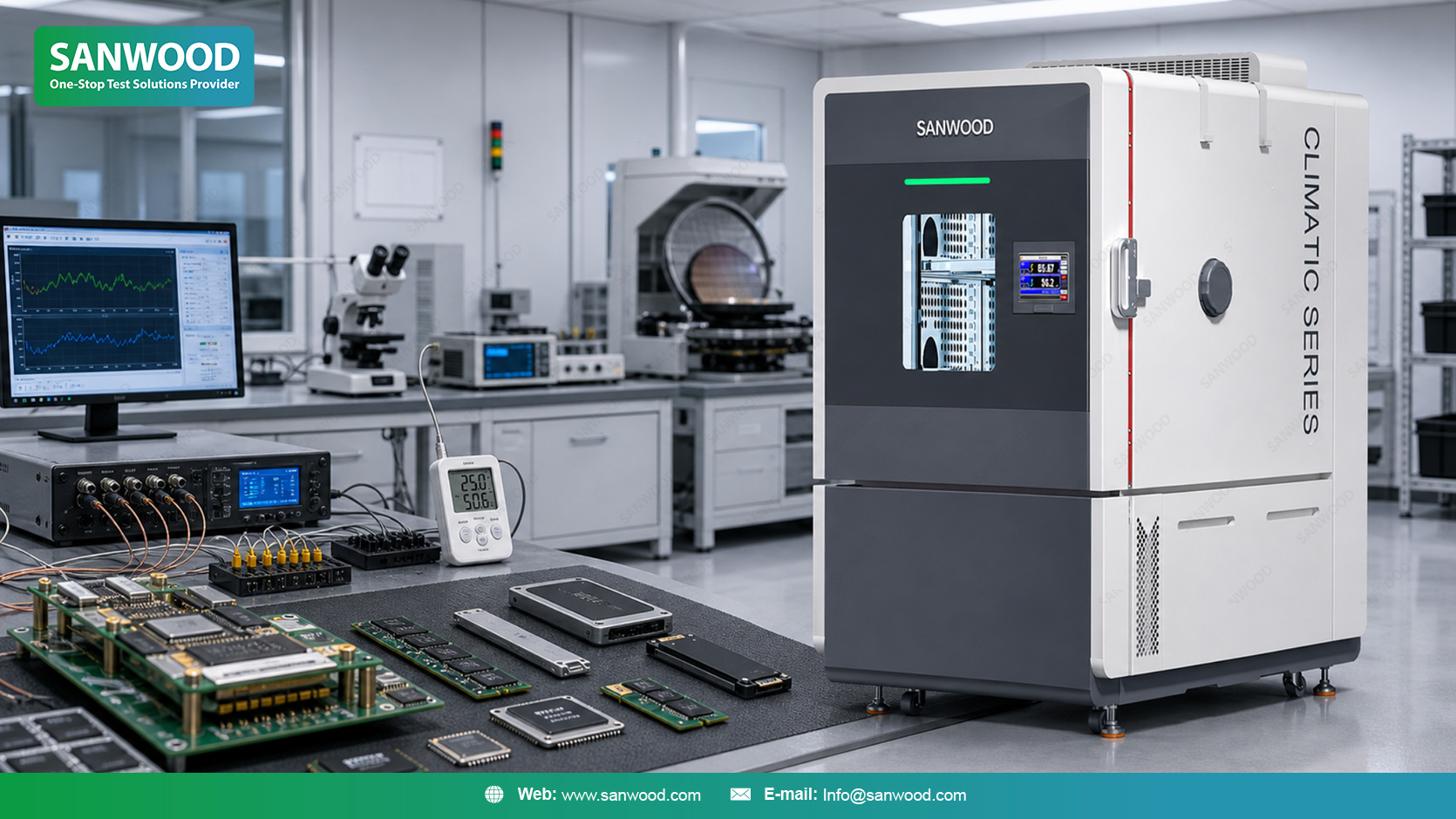
AI servers and edge AI systems do not rely on the processor alone. They depend on a complete hardware chain: logic devices, Memory ICs, high-bandwidth memory packages, power devices, storage modules, controllers, connectors, boards, and system-level thermal design.
When those devices move from the lab to a server room, vehicle, industrial controller, or embedded system, they see conditions that are rarely as clean as a bench test. Start-up at low temperature, long high-temperature operation, humidity exposure during storage or transport, repeated thermal stress, and powered operation under workload can all affect long-term behavior.
For semiconductor and memory suppliers, reliability data is part of the product story. Customers want to know that the device is not only fast on paper, but stable across the conditions it is likely to meet in real use.
Temperature range is usually the first specification people check when choosing an environmental test chamber. It is important, but it does not tell the whole story.
For semiconductor samples, the quality of the test result also depends on temperature stability, temperature uniformity, ramp rate, recovery time, airflow design, fixture layout, cable routing, and sample loading. If the chamber cannot hold repeatable conditions, the test may say more about the chamber limitation than the device under test.
In early engineering work, a High and Low Temperature Test Chamber can help teams observe how ICs, memory modules, eMMC devices, MCU products, and storage assemblies respond to cold start, high-temperature operation, and storage conditions.
The point is not only to expose the device to a cold or hot condition. The point is to run a controlled stress profile that can be repeated, compared, and used for engineering decisions.
Humidity is easy to underestimate because its effect is not always immediate. Moisture can interact with package materials, interfaces, insulation resistance, corrosion paths, solder joints, and long-term electrical stability. In memory modules and packaged ICs, humidity stress may become more important when it is combined with temperature and time.
A Temperature Humidity Test Chamber gives engineers a controlled way to evaluate temperature and moisture exposure together. It can support design validation, material comparison, process checks, and reliability testing for electronic components and semiconductor-related assemblies.
For accelerated moisture-related evaluation, some projects may require HAST. This depends on the device type, package structure, test plan, and customer requirements.
In those cases, a HAST Accelerated Aging Test Chamber can help teams apply high temperature, high humidity, and pressure conditions to shorten the time needed to investigate moisture-related risks.
For memory and storage products, reliability is not limited to whether the device powers on. Engineers may need to watch data stability, read-write behavior, controller response, timing drift, leakage, solder joint integrity, and module-level behavior across temperature and humidity conditions.
Enterprise SSDs in AI data centers may face continuous operation, high workload, elevated temperature, and maintenance pressure. eMMC devices in automotive, industrial, or edge equipment may face wide temperature swings and long service life. Memory ICs and MCU devices may require powered aging or dynamic operation to expose early weaknesses.
This is why the test plan should begin with the use case. A qualification test for a Memory IC is not the same as a high-low temperature operation test for an enterprise SSD. An eMMC validation project may need different fixture space, wiring access, monitoring points, and sample loading than a board-level test.
For semiconductor and electronics reliability work, SANWOOD Technology provides environmental test chambers for temperature, humidity, rapid temperature change, HAST, and related reliability test scenarios.
In real projects, the most useful discussion usually starts with the test condition rather than the catalog model. A reliability lab needs to know the sample type, sample size, loading quantity, temperature range, humidity range, ramp rate, test duration, whether the device is powered, and what data must be monitored during the test.
For standard temperature and humidity validation, SANWOOD can review chamber configuration around a Temperature and Humidity Test Chamber. For projects that need faster thermal transitions, a Rapid Temperature Change Test Chamber may be more suitable. For moisture-accelerated evaluation, engineers may consider a HAST Accelerated Aging Test Chamber when the test method calls for it.
The goal is not to recommend the largest chamber or the widest temperature range by default. The goal is to match the chamber to the device, fixture, sample loading, and reliability question.
Before choosing equipment for AI chip, memory, or semiconductor-related testing, it is useful to clarify:
- What is being tested: IC, Memory IC, MCU, eMMC, enterprise SSD, module, board, or packaged component?
- Will the sample be powered or monitored during the test?
- What temperature and humidity conditions are required?
- How many samples will be loaded at one time?
- Is the project focused on R&D validation, qualification, failure analysis, or batch screening?
- Are special fixtures, cable ports, shelves, sample racks, or safety considerations needed?
- What data should be recorded, and how repeatable must the test profile be?
These details directly affect chamber size, airflow layout, temperature and humidity performance, wiring design, and the practical usability of the test setup.
As AI hardware becomes more capable and more expensive, reliability evidence becomes more valuable. Semiconductor customers do not only want to see benchmark data. They also need confidence that the device can survive realistic environmental stress.
Temperature and humidity validation helps build that confidence. It gives engineering teams a clearer view of device behavior before field problems become expensive. It also helps quality teams compare materials, processes, suppliers, and design changes with better discipline.
For AI chips, Memory ICs, MCU devices, eMMC products, and enterprise SSDs, environmental testing is no longer just a final checkbox. It is part of development, qualification, customer approval, and long-term product reliability.
If your team is planning semiconductor or memory reliability testing, share the device type, sample size, temperature range, humidity range, test duration, and powered-test requirements. SANWOOD can help review the chamber configuration and suggest a practical test setup for your application.
Sanwood is not just a company; it is a commitment to delivering high-quality products that stand the test of time.

 English
 中 文
中 文


 info@sanwood.com