2026-06-06 11:34:14
Designed to comply with industry standards such as JEDEC, AEC-Q100, MIL-STD, and IEC 60068, SANWOOD solutions support semiconductor manufacturers throughout R&D verification, package qualification, production quality control, and compliance certification. By delivering accurate and repeatable environmental simulation, SANWOOD helps customers improve product reliability, reduce failure risks, and accelerate qualification processes.
More than 70% of semiconductor failures are caused not by design defects, but by reliability issues that develop under long-term environmental stress. Even devices that pass initial electrical testing can experience package delamination, solder joint fatigue, corrosion, and parameter drift during real-world operation.
As semiconductors are increasingly used in automotive electronics, industrial control systems, aerospace equipment, AI servers, and other high-reliability applications, semiconductor reliability testing has become a critical process for chip development, package qualification, manufacturing quality control, and mass production.
Core Causes of Semiconductor Failures
Throughout storage, transportation, and field operation, semiconductor devices are continuously exposed to temperature, humidity, and mechanical stress, which are among the primary causes of reliability degradation.
Temperature Stress
Repeated high- and low-temperature exposure causes different materials within semiconductor packages to expand and contract at different rates. Over time, this may result in:
Package delamination
Wire bond degradation
Solder joint fatigue cracking
Electrical parameter drift
These failure mechanisms are commonly evaluated through Temperature Cycling Tests (TCT) and Thermal Shock Tests.
Humidity Stress
High-temperature and high-humidity environments accelerate moisture absorption within packaging materials. Under electrical bias, moisture can cause:
Metal corrosion
Ionic migration
Increased leakage current
Insulation degradation
Such risks are typically assessed through HAST and temperature-humidity testing.
Mechanical Stress
Mechanical stress generated by transportation, vibration, thermal expansion, or operational shock can introduce hidden defects such as wafer microcracks and solder joint fractures. These issues are often difficult to detect through conventional electrical testing and require environmental simulation testing for effective screening.
Why Environmental Test Chambers Matter
Environmental test chambers are designed to accurately simulate the operating conditions semiconductor devices may encounter throughout their service life.
By accelerating environmental stress, these systems help engineers identify potential weaknesses in product design, manufacturing processes, and material selection before products enter the market.
Common semiconductor reliability tests include:
Temperature Cycling Test (TCT)
Thermal Shock Test
Rapid Temperature Change Test
Temperature and Humidity Test
HAST (Highly Accelerated Stress Test)
Environmental Stress Screening (ESS)
Through standardized environmental testing, manufacturers can reduce early-life failures, improve product reliability, and minimize the risk of field returns.
Compliance with Industry Standards
Reliability testing is essential for meeting international qualification and certification requirements.
Major standards include:
JEDEC JESD22 – Semiconductor reliability testing
AEC-Q100 – Automotive integrated circuits
MIL-STD – Military and aerospace applications
IEC 60068 – Environmental testing of electronic products
The accuracy, temperature uniformity, humidity control, and long-term stability of environmental test chambers directly affect the validity and repeatability of test results.
SANWOOD Semiconductor Testing Solutions
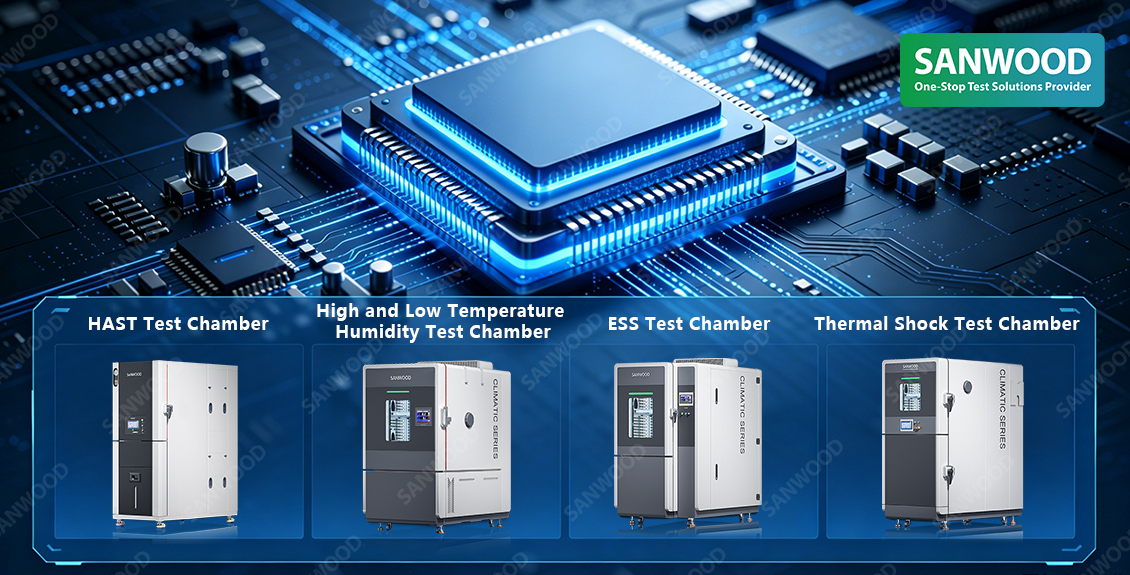
With extensive experience in environmental simulation technology, SANWOOD provides a comprehensive range of semiconductor reliability testing equipment, including:
Designed to comply with industry standards such as JEDEC, AEC-Q100, MIL-STD, and IEC 60068, SANWOOD solutions support semiconductor manufacturers throughout R&D verification, package qualification, production quality control, and compliance certification.
By delivering accurate and repeatable environmental simulation, SANWOOD helps customers improve product reliability, reduce failure risks, and accelerate qualification processes.
Sanwood is not just a company; it is a commitment to delivering high-quality products that stand the test of time.

 English
 中 文
中 文


 info@sanwood.com