2025-12-12 14:00:24
Aerial devices find widespread application in extreme environments like firefighting, how can we ensure their stable and reliable operation amidst complex, demanding conditions? Sanwood Technology delivers dependable solutions.
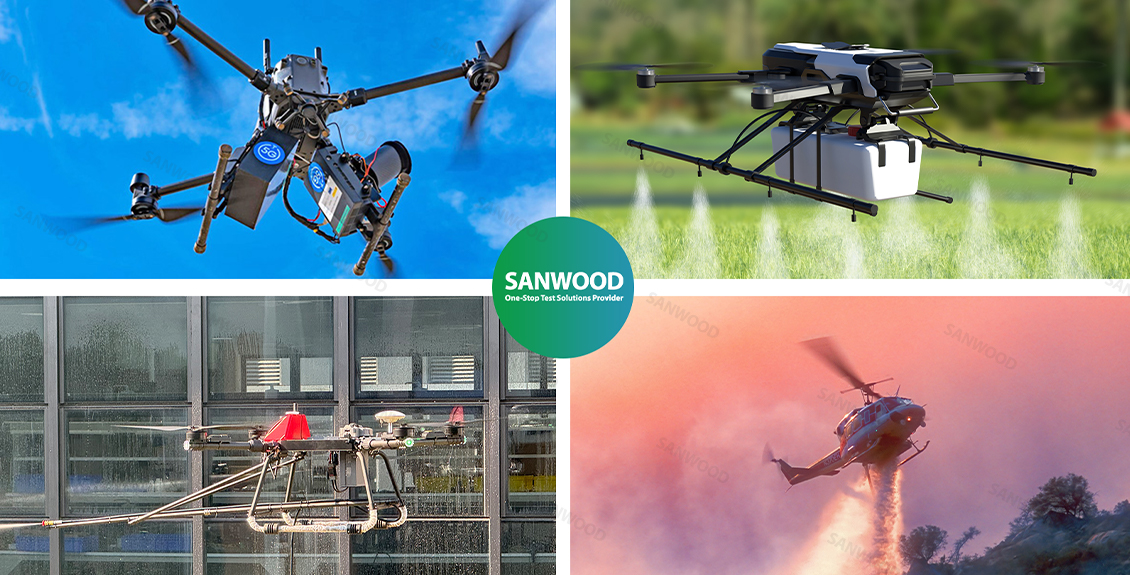
Recently, a fire incident trended on social media, sounding the alarm for fire safety during autumn and winter. Once, it was firefighters charging into danger; now, with advancing technology, drones are increasingly integrated into daily life, significantly aiding firefighting efforts and becoming a new driving force for societal progress.
Yet, as these aerial devices find widespread application in extreme environments like firefighting, how can we ensure their stable and reliable operation amidst complex, demanding conditions? Sanwood Technology delivers dependable solutions.
Industry Landscape
In recent years, the global drone market has experienced explosive growth. As application scenarios continue to expand, drones face increasingly complex and volatile operational environments. Frequent incidents of drone malfunctions, loss of control, or even crashes not only incur economic losses but also potentially jeopardise public safety. The root cause of these issues often lies in inadequate simulation of real-world operating environments during the product development phase, leading to performance degradation or complete failure under extreme conditions.
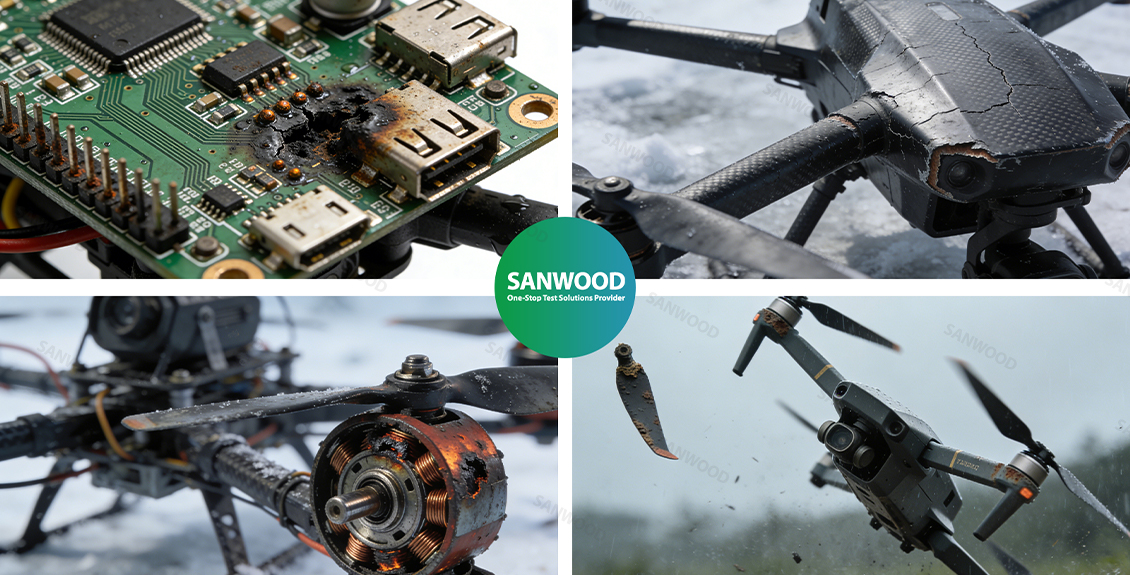
Multi-dimensional Challenges
Drones are sophisticated devices integrating flight control systems, power systems, and sensor-communication systems. Their core components are highly sensitive to environmental factors such as temperature, pressure, and humidity:
Flight Control & Circuitry
Extreme Challenges: Humidity and heat causing circuit short-circuits; thermal shock inducing solder joint fatigue.
Core Tests: Constant temperature and humidity testing, rapid thermal cycling.
Reference Standards: GJB 150.9A-2009, IEC 60068-2-14.
Composite Structures
Extreme Challenges: Thermal cycling induces micro-cracks in materials; accelerated UV ageing.
Core Tests: Thermal cycling testing, UV ageing trials.
Reference Standards: ASTM D5229, GB/T 14522.
Power Systems and Motors
Extreme Challenges: Impaired heat dissipation and efficiency reduction at low pressure; lubrication failure at low temperatures.
Core Tests: Low-pressure (altitude) testing, low-temperature start-up and operation testing.
Reference Standards: RTCA DO-160G, GB/T 2423.1.
Testing Solutions
To address these challenges, Sanwood Technology offers drone manufacturers a suite of specialised environmental simulation testing solutions:
Temperature Shock Range: -65°C to +150°C
Transition Time: ≤10 seconds
Enables thermal shock testing to validate battery endurance, electronic system performance, and other critical characteristics.
Temperature Range: -70°C to +180°C
Pressure Range: Atmospheric to 5.0 kPa
Pressure Deviation: ≤±2 kPa
Simulates high-altitude environments for low-pressure testing, assisting clients in evaluating product tolerance under reduced atmospheric conditions.
Temperature Range: -70°C to +180°C
Humidity Range: 20%RH to 98%RH
Temperature Deviation: ≤±2°C (unloaded, steady-state)
Simulates complex environments involving temperature, humidity, and vibration, supporting comprehensive product validation.
Conclusion
For any product, reliability forms the bedrock of consumer trust. Comprehensive environmental simulation testing ensures the dependability of unmanned aerial vehicles. Sanwood Technology is dedicated to providing professional, precise, and efficient environmental testing solutions for drone enterprises. We assist clients in identifying issues and optimising designs during the product development phase, thereby shortening development cycles and reducing the risk of field failures.
Sanwood is not just a company; it is a commitment to delivering high-quality products that stand the test of time.

 English
 中 文
中 文


 info@sanwood.com